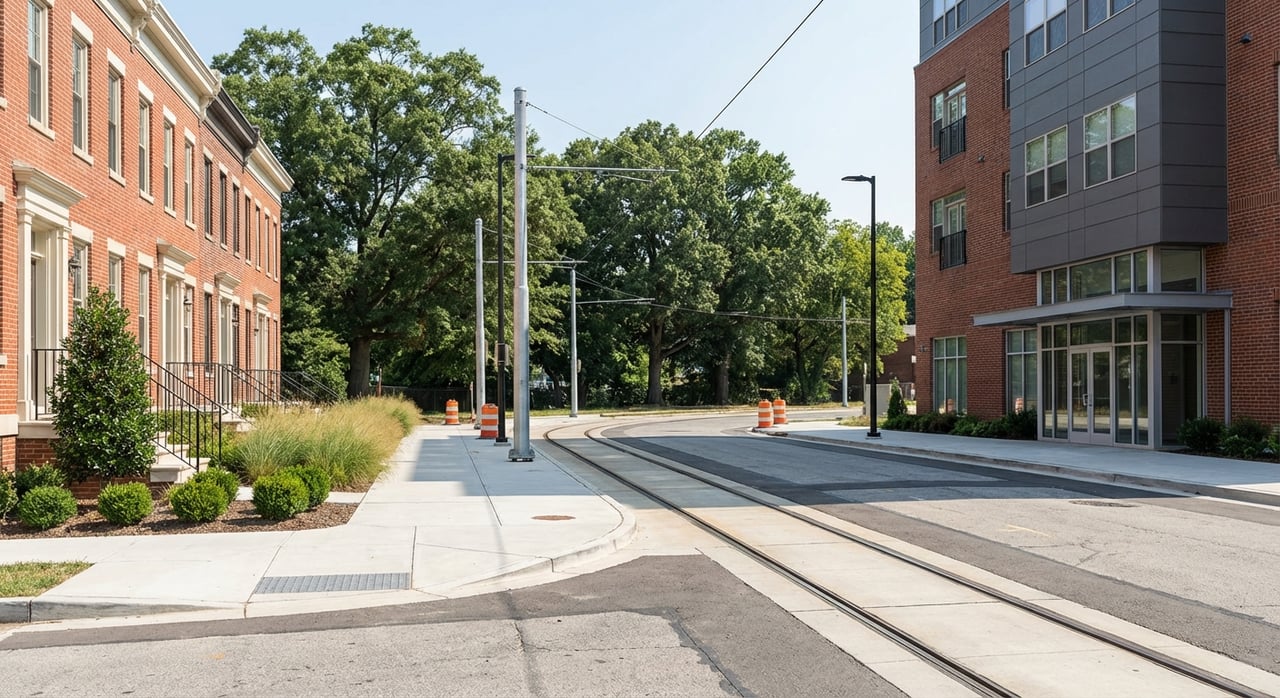
What happens when a new light-rail line links your neighborhood to jobs, schools, and entertainment across two counties without a downtown transfer? If you live in or near College Park, you are about to find out. The Purple Line is advancing through late-stage construction and testing, and it is set to serve multiple stops on and around the University of Maryland. In this guide, you will see what the official forecasts say, how transit usually influences home values and rents, and what to watch on timing and policy so you can plan your next move with confidence. Let’s dive in.
Purple Line basics in College Park
The Purple Line is a 16-mile light-rail project that will add several stations serving the University of Maryland and the College Park Metro area. According to the project’s travel-forecast technical report, five stops will serve the campus area and nearby employment centers: Adelphi/West Campus, Campus Center, East Campus, College Park Metro, and M Square/River Road. The same report projects system-wide daily boardings of about 69,300 by 2040 and shows strong usage at key College Park stations, including roughly 5,790 at College Park Metro, 4,310 at East Campus, about 1,730 at M Square, and about 730 at Campus Center. You can review those station-level estimates in the FEIS travel-forecast tables for 2040 preferred alternatives in Tables 24 and 25 of the technical report. See the FEIS travel-forecast report for details.
Commute and lifestyle impacts
Planned operations point to short headways in peak periods, longer daily spans, and frequent all-day service. The project also does not add new park-and-ride lots at most stations, which places a premium on walking, rolling, and bus transfers for access. For the system overall, the FEIS modeling assumes access patterns of about 43% walk, 33% bus, 13% Metrorail, and 10% park-and-ride, which can shape foot traffic and retail demand around stations. Review the project FAQs for service characteristics and the FEIS travel forecasts for access and ridership.
For daily life, the big shift is east–west access. You will gain more direct trips to job centers like Silver Spring and Bethesda, easier transfers to Metro and MARC at College Park, and a simple way to reach destinations across Montgomery and Prince George’s counties. That convenience often increases the appeal of homes within an easy walk to stations.
College Park housing snapshot
College Park is not a typical suburban market. It is anchored by the University of Maryland and has a high share of renter-occupied homes. Place-level summaries show that about 60% of occupied housing units are renter-occupied, and the local rental market is already strong. See the College Park profile for renter share context. Recent market snapshots also show home values in the mid price bands for the region and rents above national averages. Any Purple Line effects will layer onto this baseline of student and campus-driven demand.
How demand may shift
Academic research finds that proximity to rail often carries a price premium, but the size of that effect varies by location, rail type, ridership, station design, and local policy. In other words, rail helps, but the outcome is context-dependent. A recent meta-analysis reports a meaningful positive average effect near stations, alongside wide variation. Read the peer-reviewed meta-analysis on rail and property values.
Near term: 0–5 years
- Expect stronger demand for rentals and for owner-occupied homes within a short walk of stations, especially among students, campus staff, graduate students, and early-career professionals. The FEIS anticipates the Purple Line will absorb many campus trips and replace parts of the Shuttle-UM network, which concentrates travel demand around the five campus-adjacent stops. See FEIS modeling assumptions for campus trip shifts.
Medium term: 5–15 years
- Look for more interest in multifamily and mixed-use redevelopment near stations. Prince George’s County’s transit-oriented development framework promotes compact, walkable growth in station areas, which tends to support apartments over auto-oriented uses. Review the county’s TOD goals and frameworks.
Market nuance to remember
- Single-family areas that are quiet or buffered from station activity may see smaller changes than blocks right on the alignment. At the same time, if new apartments add supply near stations, that can soften price pressure on nearby single-family homes while changing rental dynamics. The literature documents both premium and discount effects based on microconditions. See the variability discussion in the meta-analysis.
Housing types to watch
- Multifamily rentals and mixed-use buildings near walkable station sites, aligning with county TOD priorities. County TOD guidance outlines these goals.
- Purpose-built student housing near campus stations, supported by the Purple Line’s role in campus travel. UMD has stated that intra-campus trips among the five campus stops will be fare-free for students, faculty, and staff, which further concentrates student travel near stations. See UMD’s Purple Line FAQs and FEIS modeling context.
- “Missing middle” housing forms like duplexes and fourplexes, possible where local zoning supports them. The county’s TOD and equitable development efforts can enable these options over time. Explore county TOD materials.
Timing and construction updates
The Purple Line is in late construction and dynamic vehicle testing. Official pages describe ongoing nighttime train testing and note that schedules are contingent on safety certification. The project has published a target that references winter 2027, but dates have shifted in the past. Always verify timing against the project’s official updates before making move plans. Start with the Purple Line FAQs and the document library for current materials.
Risks and safeguards to watch
- Affordability pressures and displacement risk can increase in renter-heavy neighborhoods after new transit opens. Planning documents and local partners are pairing TOD with equity programs, small-business support, and affordable housing strategies to mitigate these effects. See Prince George’s County TOD priorities and the FEIS discussions of social effects and mitigation.
What this means if you plan to buy or sell
- If you want a short, car-light commute: Focus your search within a comfortable walk of East Campus, Campus Center, College Park Metro, or M Square. Visit at different times of day to gauge noise, lighting, and foot traffic.
- If you value quieter streets: Look at blocks that are walkable but set slightly back from the alignment. Microconditions matter for comfort and resale.
- If you are a seller near a future station: Prep smartly. Small updates, strong staging, and polished marketing can help you capture rising demand tied to new transit. Compass Concierge can fund approved improvements that you repay at closing, which can help you list faster and net more.
- If you are an investor or value-add buyer: Watch for mixed-use and small multifamily opportunities close to stations and near campus. Underused sites can change use patterns as rail opens, especially where county TOD policy supports higher-intensity development.
College Park is already a dynamic market with a large renter base and a major university. The Purple Line will layer in new access and options. To navigate the changes with a clear plan and on-the-ground guidance, connect with the local team that knows these streets, policies, and buildings. Reach out to The Foley Group for a tailored strategy for your next move.
FAQs
When will the Purple Line open in College Park?
- The project is in late construction and testing, and official pages have referenced a winter 2027 target, but all dates remain subject to certification; always confirm with the Purple Line FAQs.
Which College Park stations are forecast to be busiest?
- The FEIS projects about 5,790 daily boardings at College Park Metro and about 4,310 at East Campus by 2040, with other campus stops like M Square and Campus Center lower; see Tables 24–25 in the FEIS travel-forecast report.
How might the Purple Line affect home values near UMD?
- Studies show a positive average effect near rail with wide variation; outcomes in College Park will depend on station design, walkability, new housing supply, and policy; review the rail-and-values meta-analysis.
Will there be new parking at Purple Line stations in College Park?
- The project does not add new park-and-ride lots at most stations and relies on existing facilities at Metrorail-connected nodes; see the project FAQs.
What housing types are most likely near stations?
- Expect more multifamily rentals and mixed-use projects, along with student-oriented housing near campus, consistent with Prince George’s TOD goals and FEIS station-area context.
How will the Purple Line change student and campus trips at UMD?
- UMD has announced fare-free intra-campus use among the five campus stops for students, faculty, and staff, and the FEIS anticipates a shift of Shuttle-UM trips to rail; see UMD’s Purple Line FAQs.
What should a homeowner near a future station do before listing?
- Tackle high-impact updates, stage thoughtfully, and time your launch around construction milestones; programs like Compass Concierge can help fund prep so you list polished and fast.