Most guides to buying an old house treat a buried oil tank as a repair line item: find it, price it, negotiate it, move on. In Hyattsville's Historic District, that framing misses the part that actually derails timelines. The problem isn't the tank. It's that digging it up counts as exterior work in a district where exterior work gets reviewed, and that review can run on a slower clock than your mortgage commitment date.
If you're buying or selling a pre-1940s home anywhere between the Checkerboard Block on Emerson Street and the oldest houses near 42nd Avenue and Gallatin Street, this is worth understanding before you're the one standing in a basement pointing a flashlight at a capped pipe.
The clue is usually already in the yard
Hyattsville's oldest housing stock was built for oil heat, because that's what was available. Victorian-era homes went up from the Civil War through the early 1900s. Starting around 1905, the ornate Victorian style gave way to Craftsman bungalows and Foursquares, many of them purchased as mail-order kits, including Sears and Roebuck house kits sold beginning in the 1920s. Colonial Revival and Cape Cod styles followed as the Craftsman wave faded roughly 25 years after it started.
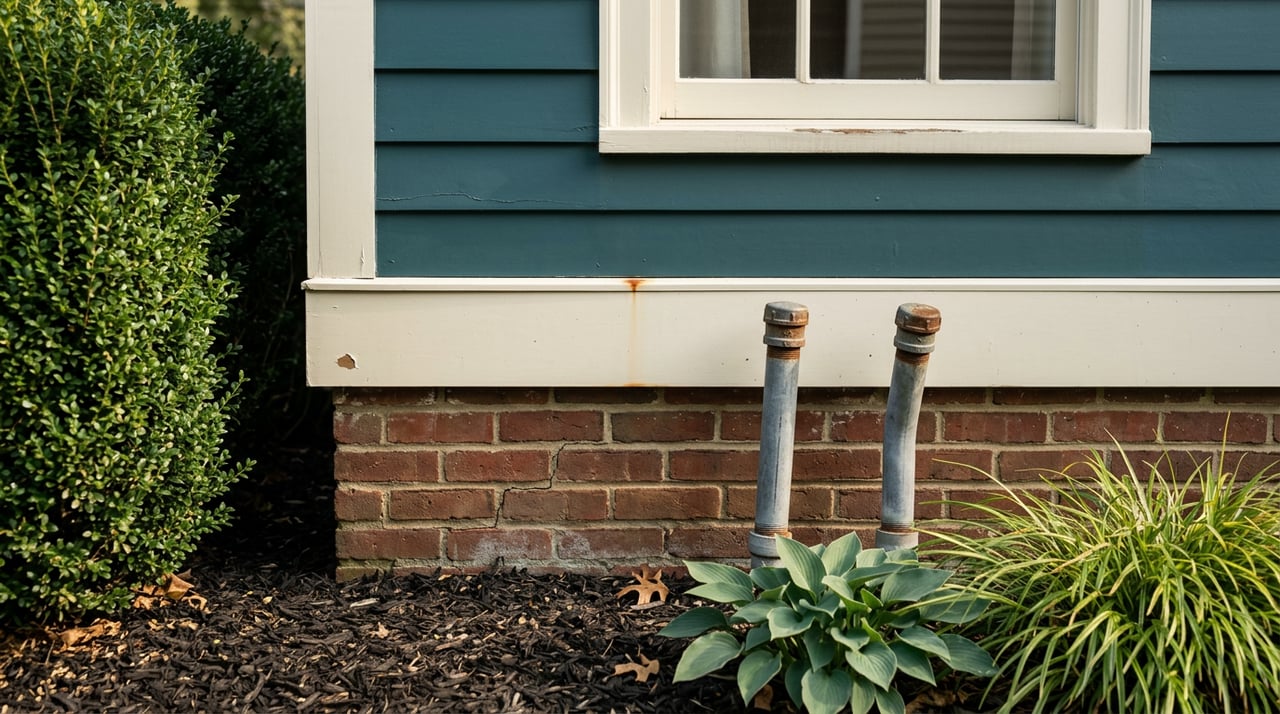
Almost none of these houses had gas service on day one. If a home in this age range now runs on gas or has a newer oil system, there's a reasonable chance an older tank is still in the ground, decommissioned properly or simply forgotten. The visible tells are consistent regardless of architectural style: a capped fill pipe and vent pipe standing a foot or two above grade near the foundation, abandoned copper fuel lines in the basement, a patched section of foundation wall, or an old oil burner switch nobody bothered to remove. None of these require a specialist to spot. They just require someone to look.
What you're actually required to say
Maryland law gives sellers two paths: a full Residential Property Disclosure Statement listing known defects, or a Disclaimer Statement selling the home "as-is." Either way, the standard state form asks directly about underground storage tanks, and a disclaimer doesn't get a seller out of disclosing a defect that's both hidden and a safety or environmental concern. A buried tank with no closure paperwork fits that description.
Prince George's County adds its own layer on top. The county's Disclosure and Notice Addendum, used with every residential contract in the county, requires sellers to separately certify whether the property sits in a designated historic district, along with other county-specific notices. For a Hyattsville Historic District listing, that means two overlapping disclosure obligations arrive in the same contract packet: one about what's buried in the yard, one about what review process governs the yard itself. Sellers who treat these as the same paperwork often miss that they're answering two different questions.
Twenty years is the number that matters
Maryland's Department of the Environment doesn't actively regulate most residential heating oil tanks while they're in normal use, but it does publish a clear recommendation: tanks older than 20 years should be replaced. Given that Hyattsville's oil-heat housing stock dates to the first half of the twentieth century, any tank still in the ground from that era is decades past that threshold, not marginally past it.
Environmental contractors who handle this work across Maryland routinely describe buried residential tanks as almost never within their expected service life by the time anyone finds them.
That framing matters for negotiation. This isn't a "maybe it's fine" inspection item. If a tank has been buried since a house converted to gas sometime in the mid-twentieth century, the working assumption should be that it needs professional attention, not monitoring.
The permitting collision nobody budgets for
Here's the part that's specific to buying or selling inside the Historic District boundary rather than just an old house anywhere in Prince George's County.
An out-of-service tank has to be removed or properly abandoned within 180 days of falling out of use, and abandonment isn't a shortcut. Maryland practice requires the tank to be cut open and cleaned even if it stays in the ground, and both removal and abandonment require a soil sample sent to a lab. None of that is unique to Hyattsville. What is unique is what happens next if the property sits inside the boundary of the district that has encircled Hyattsville's Victorian core since 1982 and was expanded in 2004 to cover more than a thousand structures.
The City of Hyattsville's own historic preservation guidance states plainly that exterior work may require a Historic Area Work Permit from the Prince George's County Historic Preservation Commission regardless of whether it also needs a standard county building permit. Other Maryland jurisdictions with the same HAWP framework define covered work broadly enough to include grading and excavation, not just changes visible from the sidewalk. A tank dig-out involves exactly that: heavy equipment breaking ground in the yard of a house the county has an interest in preserving.
The practical result is a sequencing problem. A lender who wants the tank resolved before settlement is working off a 30 to 45 day closing calendar. A county historic commission reviewing an excavation request is not working off that calendar at all. If nobody checks which review applies before scheduling the removal crew, the tank company can be ready to dig while the paperwork that lets them dig legally is still sitting in a queue.
What a clean sequence actually looks like
For a seller who wants to get ahead of this rather than discover it mid-contract, the order matters more than the speed:
- Confirm tank status first. Look for the fill pipe and vent pipe clues, then pull any prior permits, invoices, or closure letters from your own records or the county.
- If no closure documentation exists, treat the tank as unresolved and contact a Maryland-certified tank contractor for a site evaluation before listing.
- Ask the contractor directly whether the property's Historic District status changes the permitting path, and if so, confirm with Prince George's County whether a Historic Area Work Permit applies to the planned excavation.
- Complete removal and soil testing before you accept an offer, not during the contingency period, so the disclosure form can state a resolved fact instead of an open question.
- Keep every document. The same closure report that satisfies a lender now is the same one a future seller, or your own refinance, will need to produce later.
What this means if you're the one writing the offer
Buyers get less time to work with than sellers do, which makes the visible clues worth checking before you're locked into a short inspection contingency window. If a Hyattsville listing built before 1960 shows no gas meter age consistent with an original build, or if the basement has an old burner switch with no obvious current use, ask directly whether the home ever ran on oil heat. A vague answer isn't proof of a problem, but it's a reason to request a dedicated tank sweep rather than relying on a standard visual inspection, which typically doesn't include excavation or subsurface testing. A soil sample and lab analysis for a tank site generally runs in the range of a few hundred dollars, a small cost next to what a discovered leak or a stalled historic review can do to your closing date.
If you're comparing a Hyattsville bungalow to newer construction elsewhere in the county, this is one of the genuine tradeoffs of buying into a neighborhood with this kind of architectural depth. The same porches and lot sizes that made Hyattsville "a good place to live and work" a century ago come with mechanical systems from that era too.
FAQ
How do I find out if my house in the Historic District is subject to a Historic Area Work Permit review? Contact the Prince George's County Historic Preservation Commission directly, or start with the City of Hyattsville's historic preservation resources page, which outlines when a HAWP applies and how the review process works alongside standard county permits.
Does every old Hyattsville house have a buried tank? No. Many were converted decades ago and had their tanks properly removed or abandoned with documentation. The issue only applies when there's no paper trail, which is common enough in century-old housing stock that it's worth confirming rather than assuming.
Can I sell my house with a disclaimer statement instead of full disclosure to avoid the tank question? A disclaimer statement means you're not detailing every known defect, but Maryland law still requires disclosure of latent defects that affect health or safety, and an unresolved buried tank generally falls into that category.
Is removal always better than leaving the tank abandoned in place? Contractors who do this work in Maryland generally recommend removal over abandonment, since removal gives a cleaner closure record for future sales, refinances, or insurance underwriting, even though abandonment done correctly still requires cutting, cleaning, and soil testing.
If you're weighing a purchase or a listing in Hyattsville's historic core and want a straight answer on how a property's age and location affect your timeline, The Foley Group of Go Brent Realty can walk through what's on file for a specific address before you're under contract. Get your free home valuation and we'll tell you what the paperwork already says.